
Ever wondered why certain scenes in films or plays just... Mostrar más
 Drama2 visualizaciones·Actualizado Jun 12, 2026·6 páginas
Creating a Great Setting and Atmosphere in Stories
1 / 6
1
of 6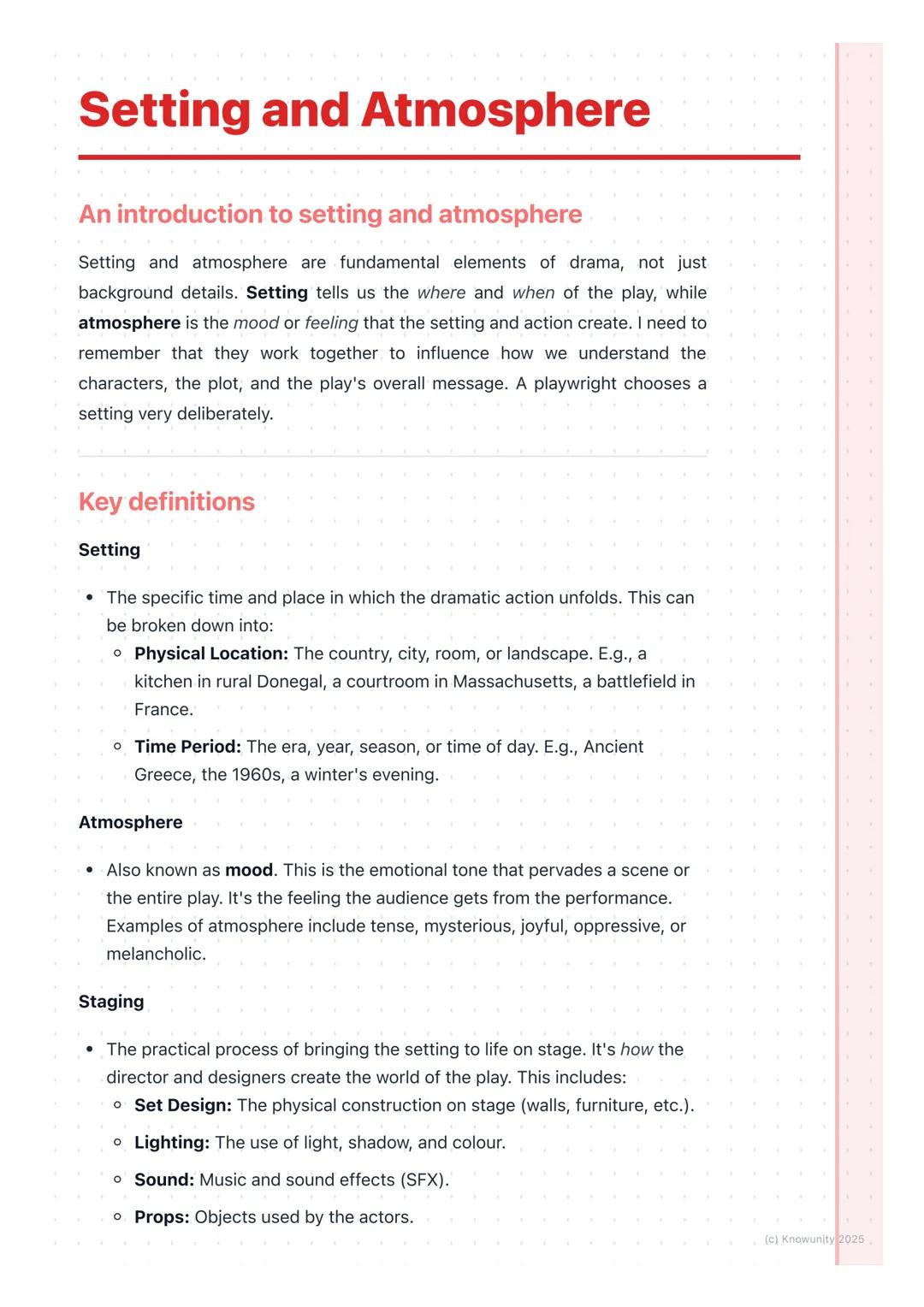
The Basics: What You Need to Know
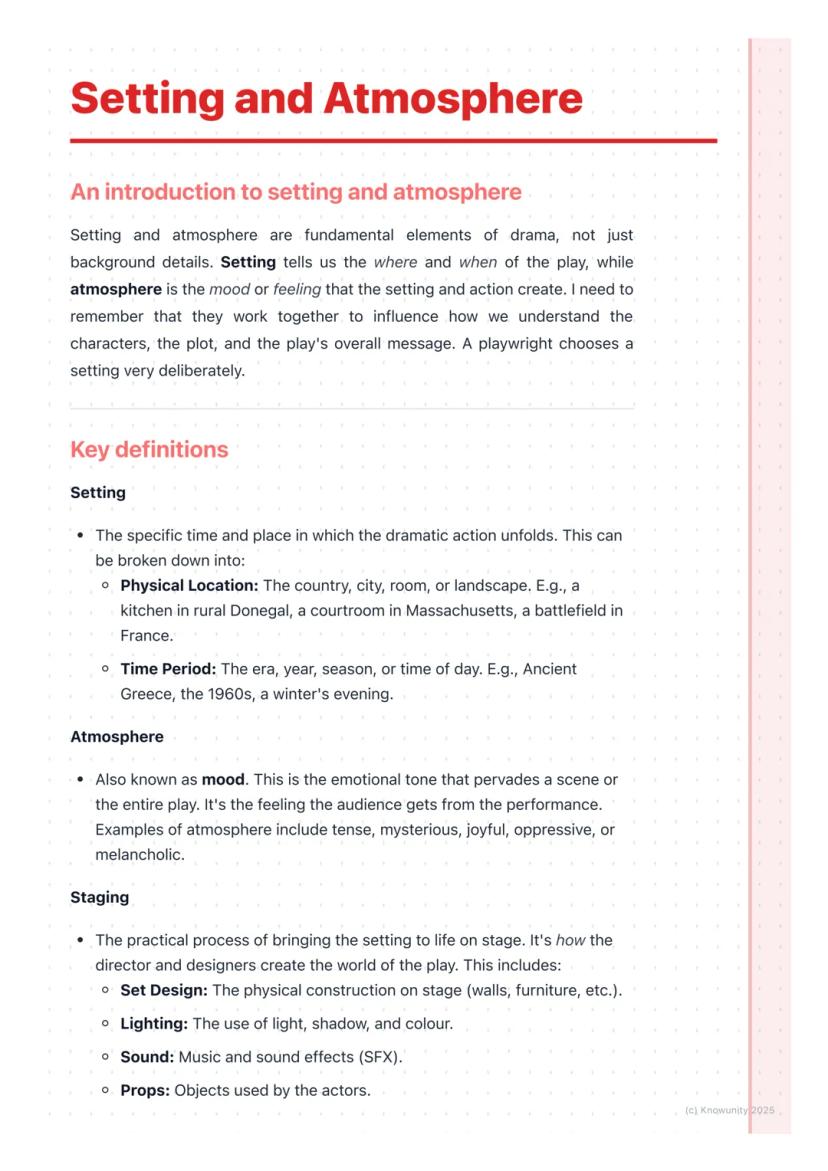
Setting is simply the when and where of your play - think physical location (a kitchen in Donegal, a courtroom in Massachusetts) plus the time period (Ancient Greece, the 1960s, a winter evening). It's not just background noise though; playwrights choose settings very deliberately.
Atmosphere (also called mood) is the emotional vibe that hits the audience. Whether it's tense, mysterious, joyful, or downright creepy, atmosphere is what makes you feel something when watching a scene.
Here's where it gets interesting: staging is how directors actually bring the setting to life on stage. We're talking set design, lighting, sound effects, props, and costumes. Think of setting as the concept (like "a decaying 1920s mansion") and staging as making that concept real on stage.
Remember: Setting is the idea, staging makes it happen, and atmosphere is what the audience feels as a result.
2
of 6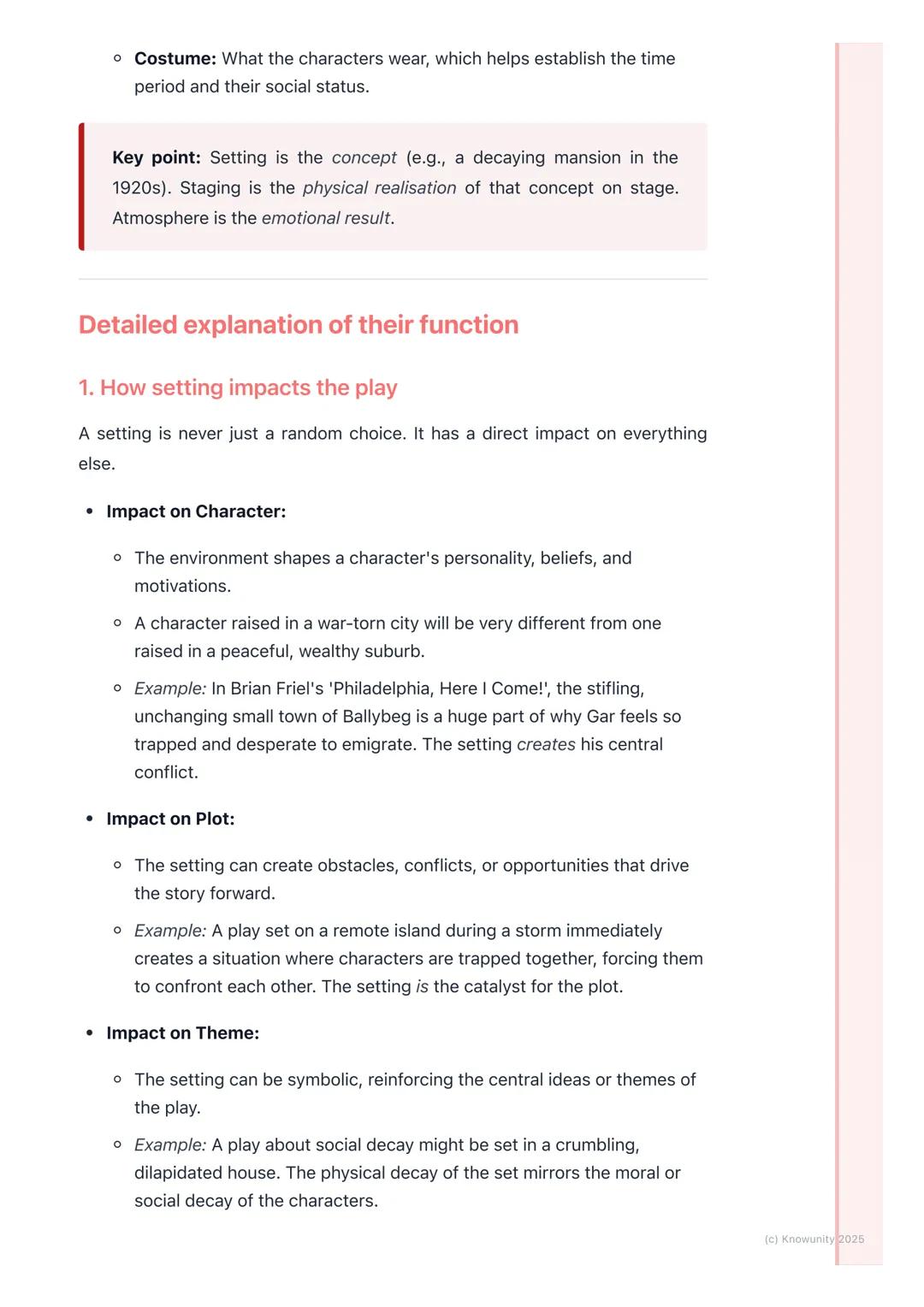
How Setting Shapes Everything
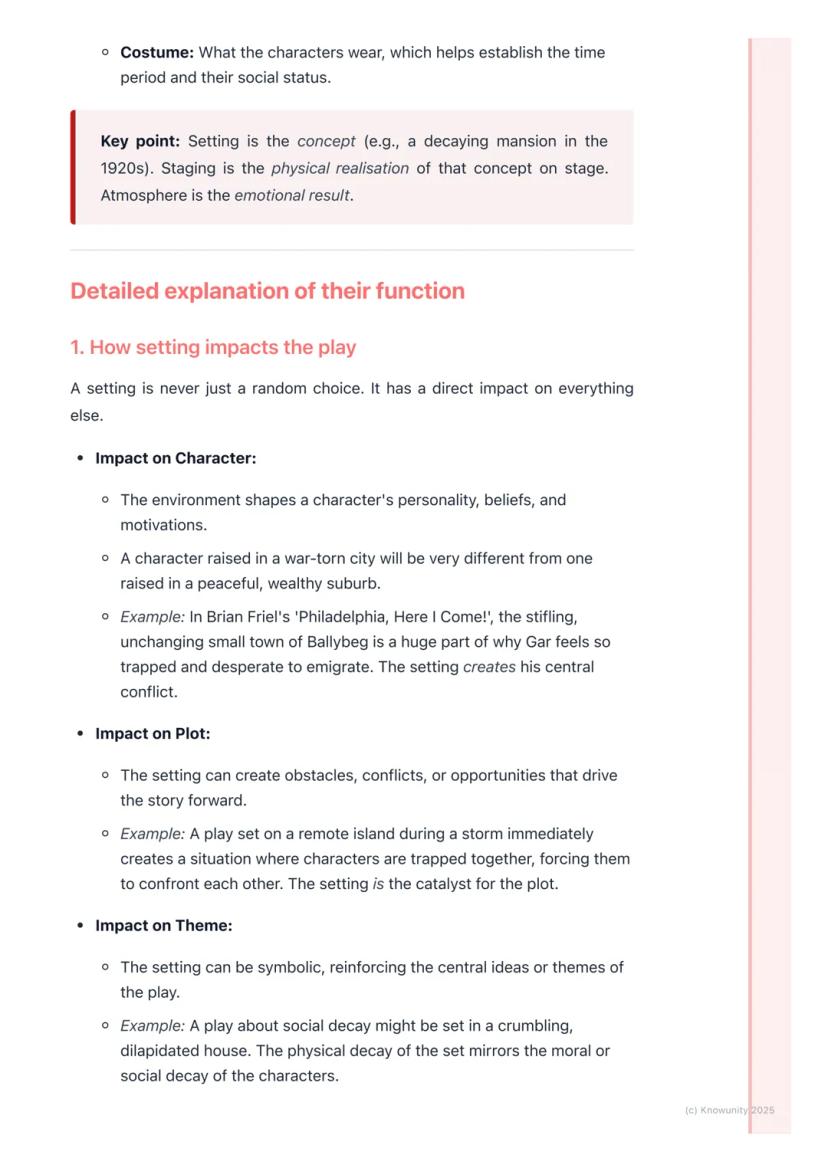
Your setting isn't just scenery - it actively moulds your characters, drives your plot, and hammers home your themes. A character from a war-torn city will be completely different from someone raised in a posh suburb, right?
Take Brian Friel's Philadelphia, Here I Come! - Gar feels trapped and desperate to emigrate partly because Ballybeg is this stifling, unchanging small town. The setting literally creates his main conflict.
Settings can also be symbolic powerhouses. A play about social decay might unfold in a crumbling house where the physical rot mirrors the characters' moral decay. It's like the set is having its own conversation with the audience.
Plot-wise, your setting can throw obstacles at characters or create opportunities that push the story forward. Picture a play on a remote island during a storm - boom, everyone's trapped together and forced to confront each other.
Top Tip: Always ask yourself WHY the playwright chose this particular setting. There's always a reason.
3
of 6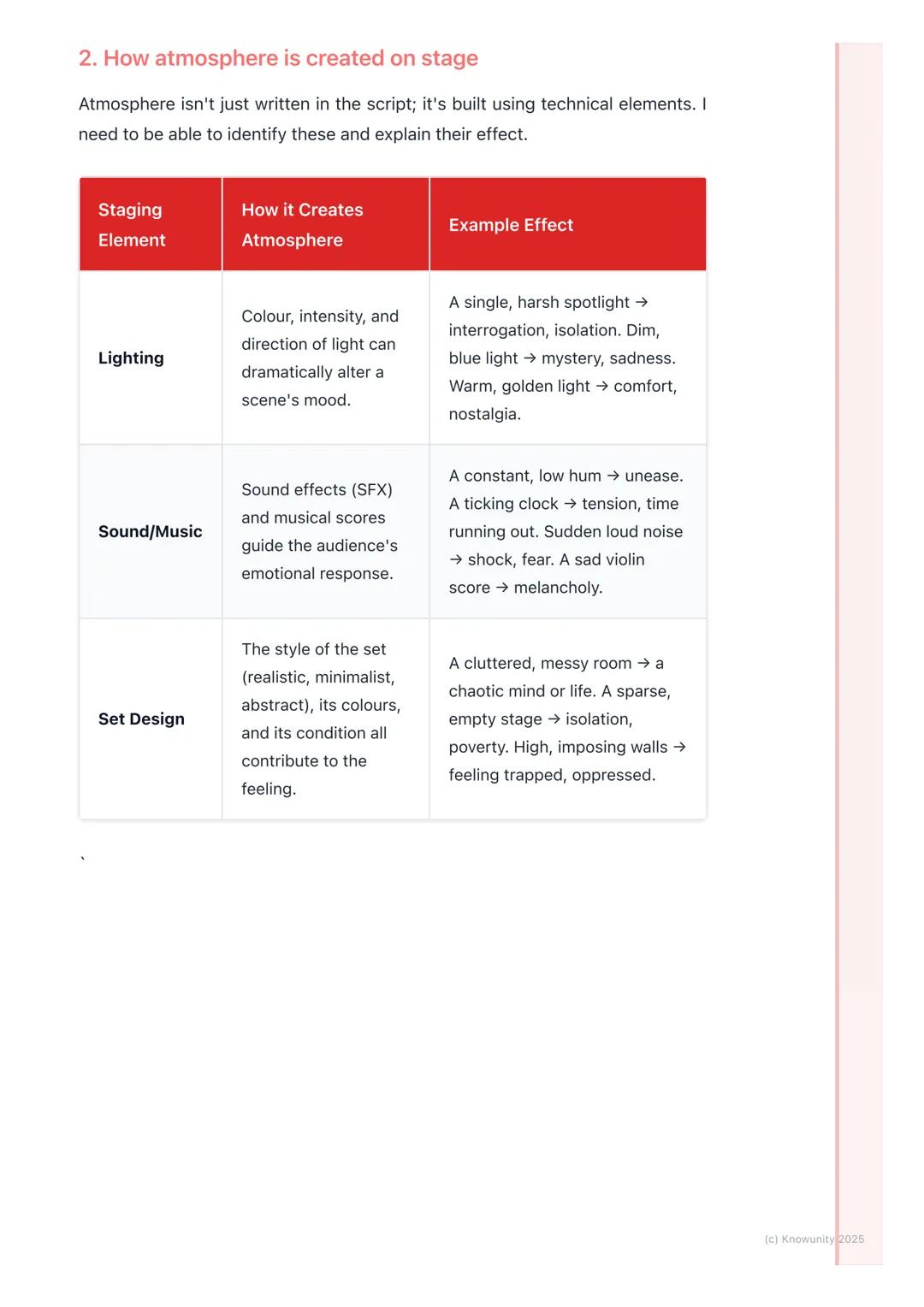
Creating Atmosphere Through Staging
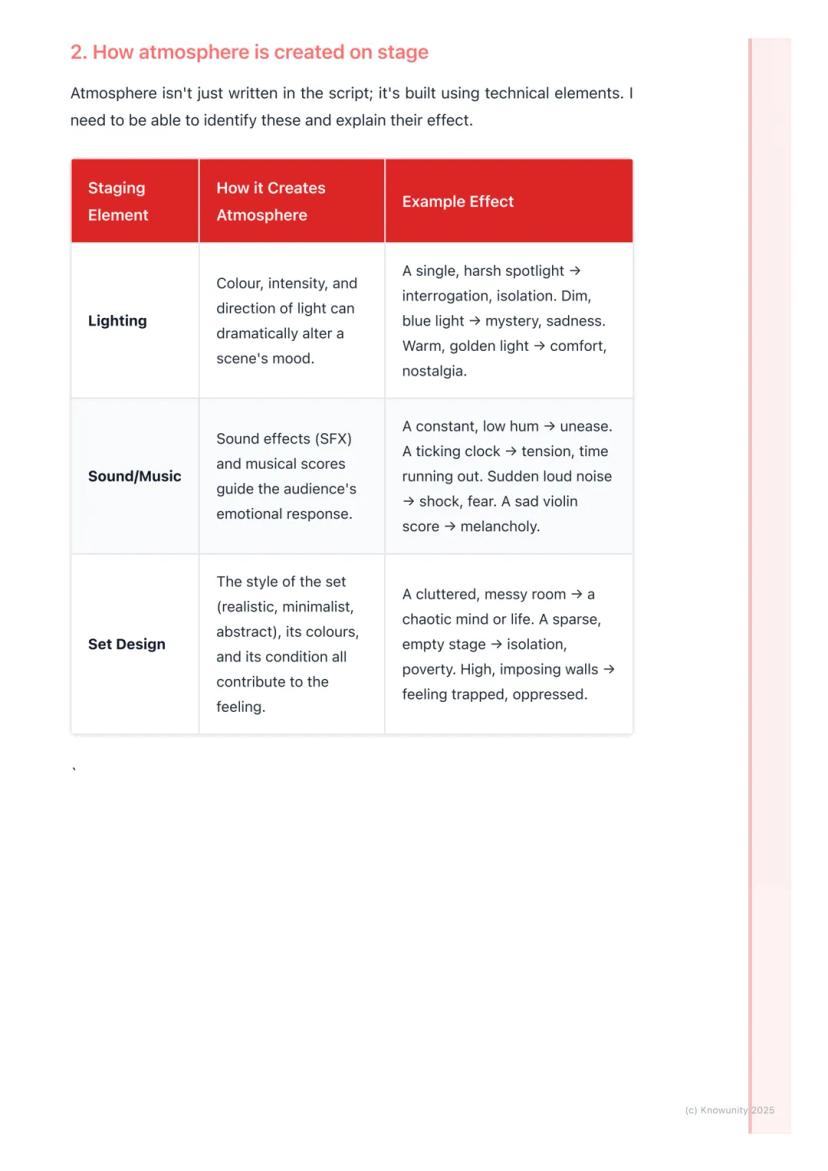
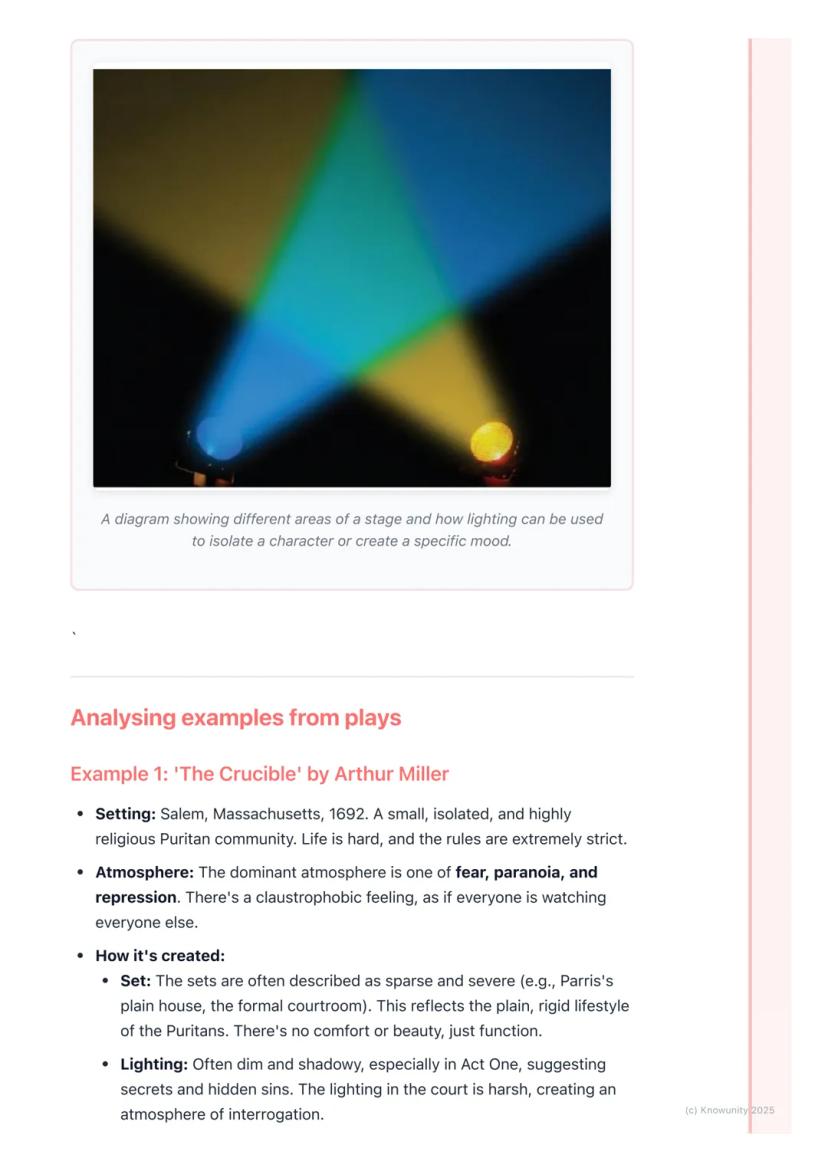
Atmosphere doesn't magically appear - directors craft it using specific technical elements that work together like a well-oiled machine. Lighting is your mood-setter extraordinaire: a harsh spotlight screams interrogation, dim blue light whispers mystery, and warm golden tones wrap you in comfort.
Sound and music guide your emotional responses whether you realise it or not. That constant low hum creates unease, a ticking clock builds tension, and a sudden loud noise makes everyone jump. Meanwhile, set design speaks volumes - a cluttered, messy room suggests a chaotic life, whilst sparse, empty stages feel isolating.
The magic happens when all these elements work together. You're not just watching a play; you're being emotionally manipulated (in the best way possible) by lighting designers, sound technicians, and set builders who know exactly which buttons to push.
Quick Check: Next time you watch anything, notice how lighting and sound make you feel - you'll be amazed how much they influence your emotions.
4
of 6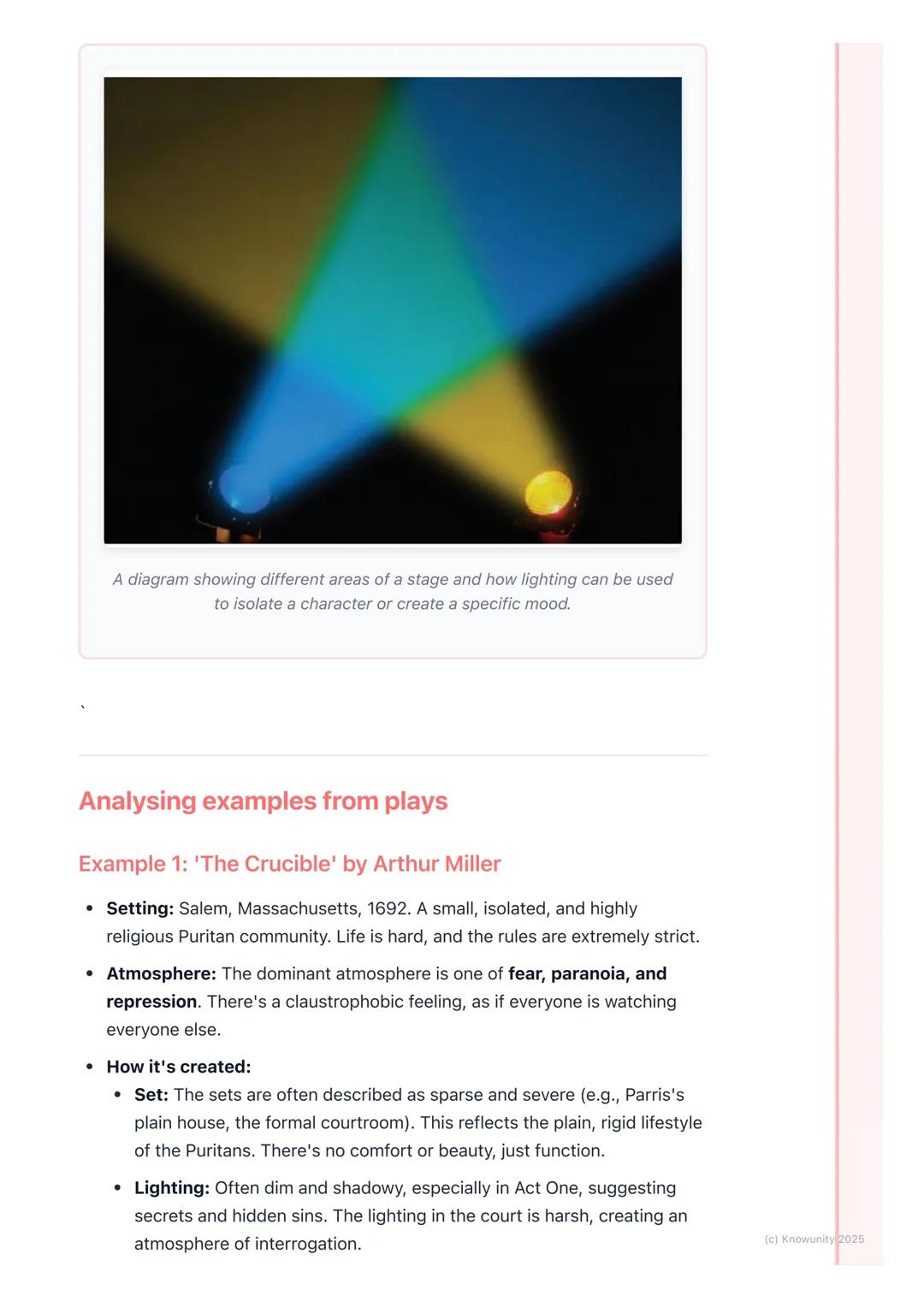
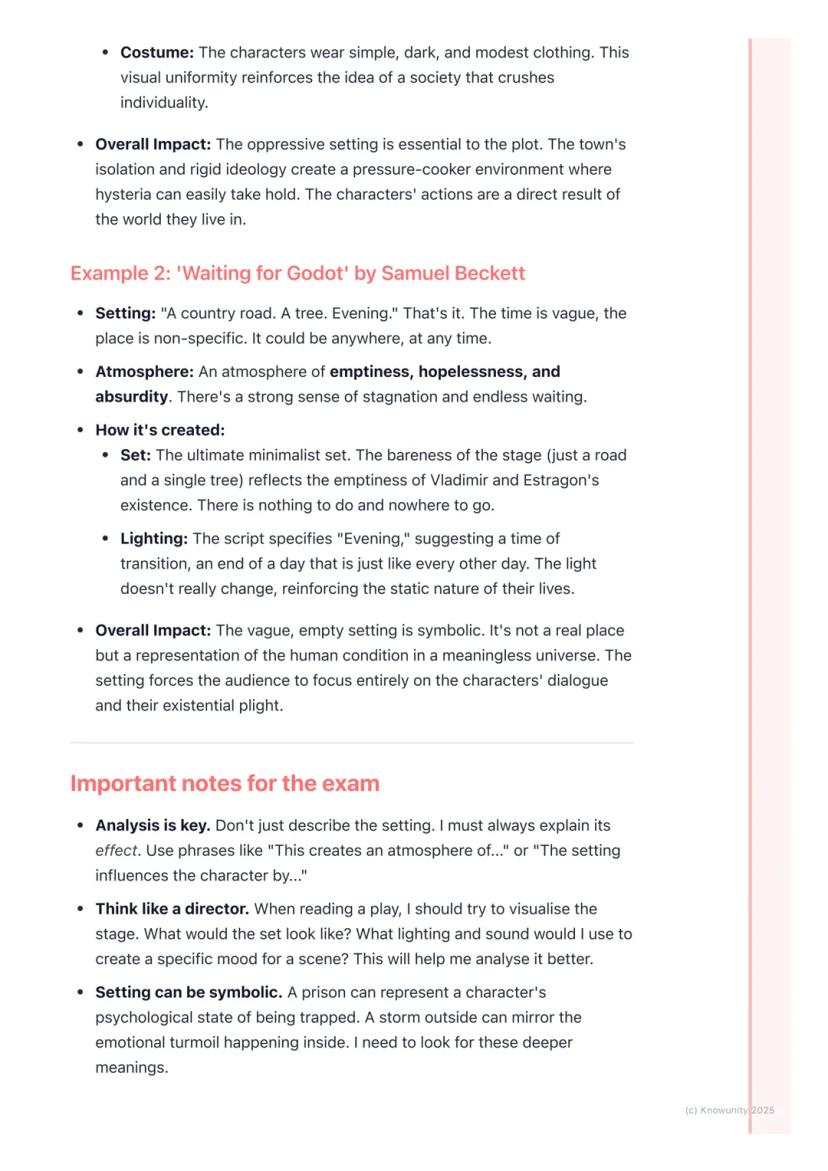
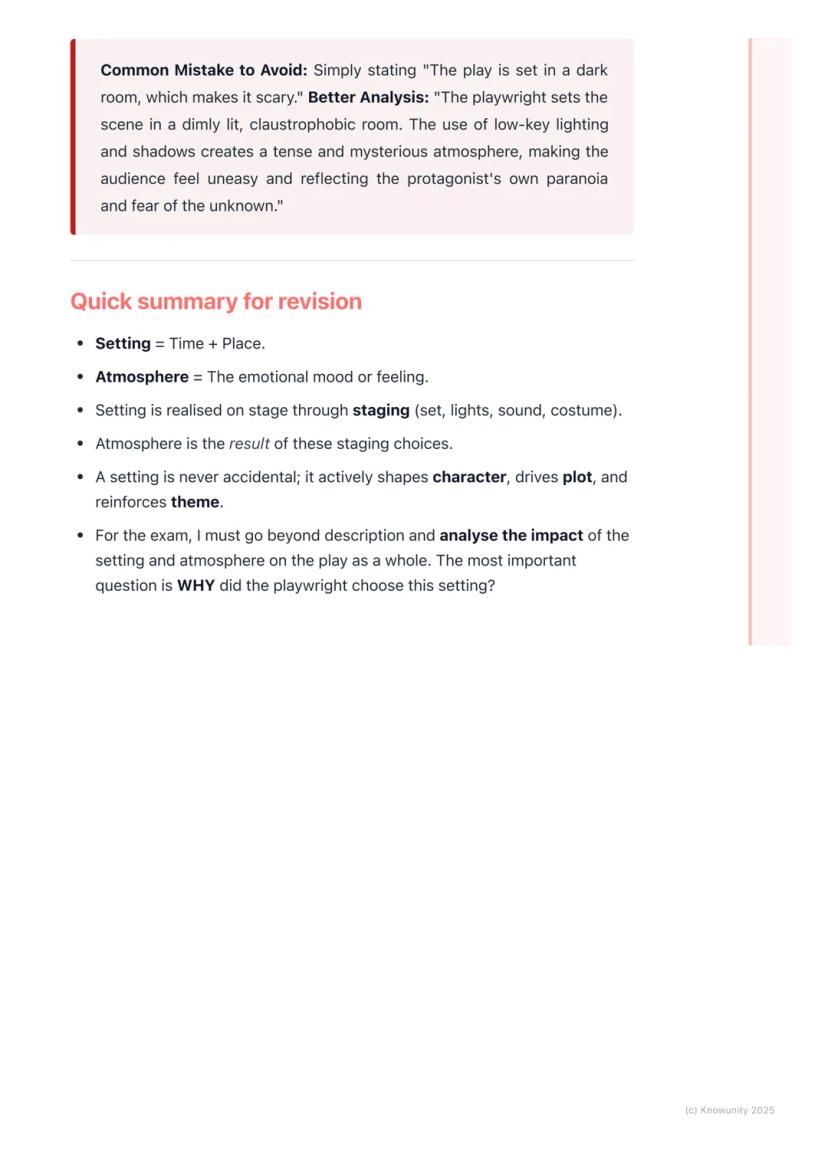
Real Examples: The Crucible
Arthur Miller's The Crucible shows setting and atmosphere working overtime. Set in Salem, Massachusetts in 1692, this isolated Puritan community creates the perfect pressure-cooker environment for hysteria to explode.
The atmosphere is pure paranoia and fear - everyone's watching everyone else, and you can practically feel the claustrophobia. Miller achieves this through sparse, severe sets that reflect the Puritans' rigid lifestyle (no comfort, just cold functionality), dim and shadowy lighting that suggests hidden secrets, and simple, dark costumes that crush any hint of individuality.
This oppressive setting isn't just backdrop - it's essential to the plot. The town's isolation and strict ideology create the exact conditions where witch trial madness can take hold. The characters' actions flow directly from the world they're trapped in.
Essay Gold: Always explain how the setting influences the characters' behaviour - this shows deeper understanding than just describing what you see.
5
of 6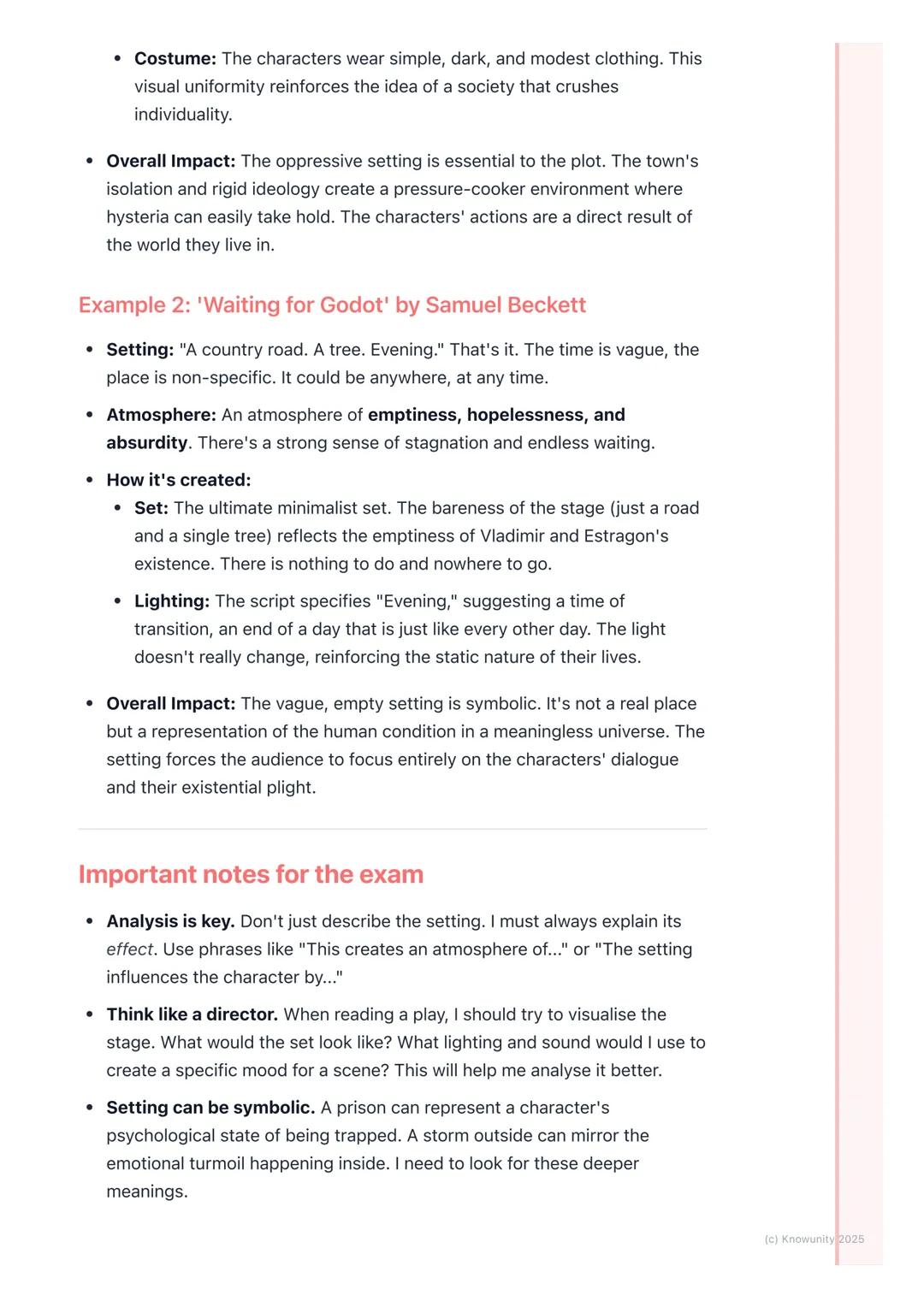
Real Examples: Waiting for Godot
Samuel Beckett's Waiting for Godot takes the opposite approach with its famously minimal setting: "A country road. A tree. Evening." That's literally it - no specific time or place, just emptiness.
This creates an atmosphere of hopelessness and absurdity. The barren stage reflects Vladimir and Estragon's empty existence - there's nothing to do and nowhere to go. The lighting barely changes, reinforcing how their lives are completely static.
The genius here is that the vague, empty setting becomes symbolic of the human condition in a meaningless universe. Without flashy sets or effects, the audience focuses entirely on the characters' dialogue and their existential struggles.
Both examples show how setting actively shapes meaning rather than just providing pretty scenery. Whether it's Salem's oppressive community or Godot's nowhere-land, the where and when of a play do serious heavy lifting.
Exam Success: Don't just describe settings - always analyse their effect using phrases like "This creates an atmosphere of..." or "The setting influences the character by..."
6
of 6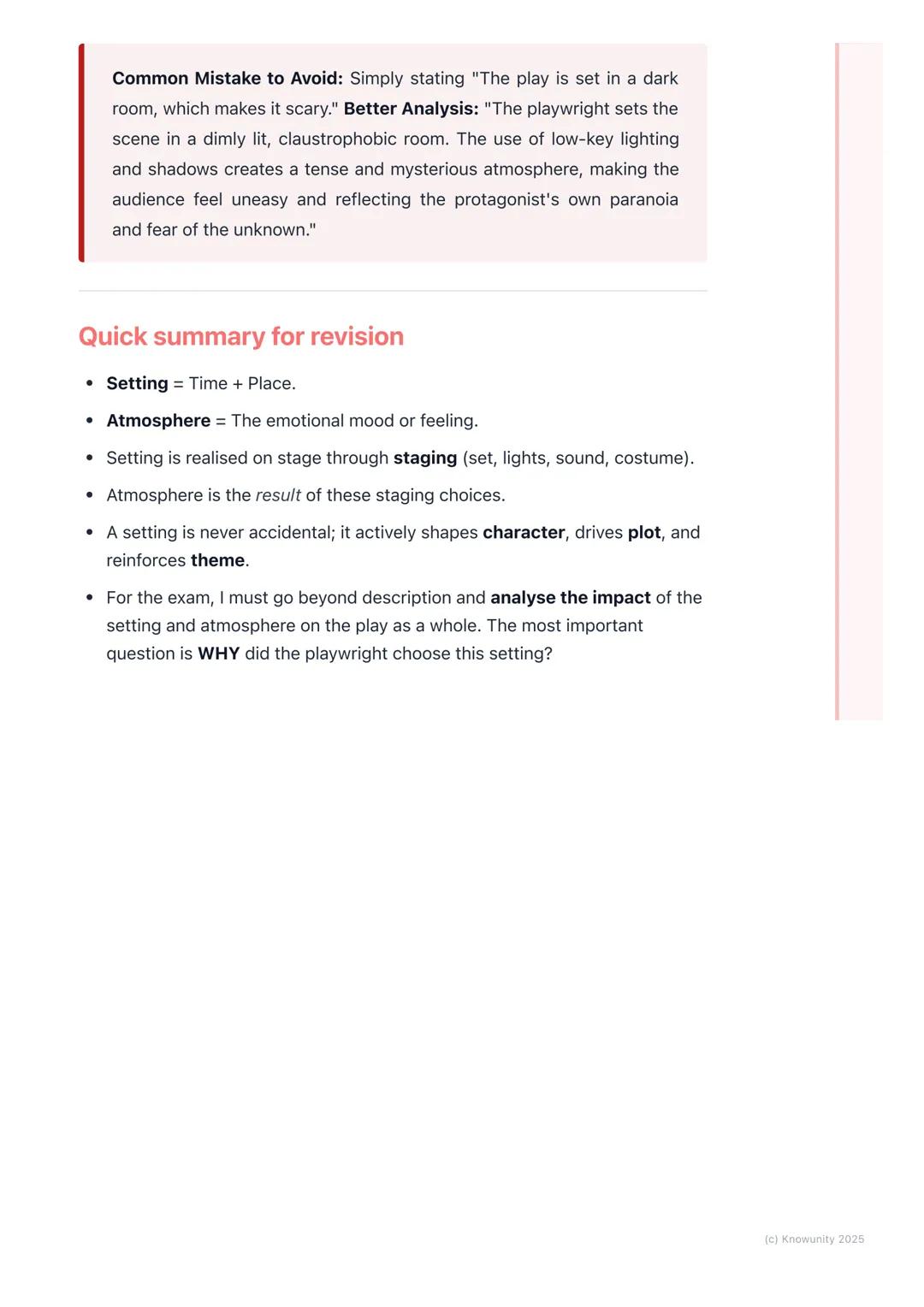
Exam Success Strategy
When tackling setting and atmosphere questions, think like a director visualising the stage. What would the set look like? What lighting and sound would create the perfect mood for each scene? This approach helps you analyse rather than just describe.
Remember that settings often work symbolically - a prison might represent psychological entrapment, whilst a storm outside could mirror emotional turmoil inside. Look for these deeper meanings that connect setting to character development and themes.
Avoid the basic trap: Don't write "The play is set in a dark room, which makes it scary." Instead, try "The playwright creates a claustrophobic atmosphere through dim lighting and shadows, reflecting the protagonist's paranoia whilst making the audience share their unease."
Your revision checklist is simple: Setting = Time + Place. Atmosphere = Emotional mood. Staging brings setting to life. Most importantly, settings are never accidental - they actively shape character, drive plot, and reinforce themes.
Final Reminder: The golden question for any exam is always WHY the playwright chose this particular setting. Answer that, and you're well on your way to top marks.
Pensamos que nunca lo preguntarías...
¿Qué es Knowunity AI companion?
Nuestro compañero de IA está específicamente adaptado a las necesidades de los estudiantes. Basándonos en los millones de contenidos que tenemos en la plataforma, podemos dar a los estudiantes respuestas realmente significativas y relevantes. Pero no se trata solo de respuestas, el compañero también guía a los estudiantes a través de sus retos de aprendizaje diarios, con planes de aprendizaje personalizados, cuestionarios o contenidos en el chat y una personalización del 100% basada en las habilidades y el desarrollo de los estudiantes.
¿Dónde puedo descargar la app Knowunity?
Puedes descargar la app en Google Play Store y Apple App Store.
¿Knowunity es totalmente gratuito?
¡Sí lo es! Tienes acceso totalmente gratuito a todo el contenido de la app, puedes chatear con otros alumnos y recibir ayuda inmeditamente. Puedes ganar dinero utilizando la aplicación, que te permitirá acceder a determinadas funciones.
Contenidos más populares
9¿No encuentras lo que buscas? Explora otros temas.
Mira lo que dicen nuestros usuarios. Les encantó — y a ti también te encantará.
4.6/5App Store
4.7/5Google Play
La app es muy fácil de usar y está muy bien diseñada. Hasta ahora he encontrado todo lo que estaba buscando y he podido aprender mucho de las presentaciones. Definitivamente utilizaré la aplicación para un examen de clase. Y, por supuesto, también me sirve mucho de inspiración.
Pablousuario de iOS
Esta app es realmente genial. Hay tantos apuntes de clase y ayuda [...]. Tengo problemas con matemáticas, por ejemplo, y la aplicación tiene muchas opciones de ayuda. Gracias a Knowunity, he mejorado en mates. Se la recomiendo a todo el mundo.
Elenausuaria de Android
Vaya, estoy realmente sorprendida. Acabo de probar la app porque la he visto anunciada muchas veces y me he quedado absolutamente alucinada. Esta app es LA AYUDA que quieres para el insti y, sobre todo, ofrece muchísimas cosas, como ejercicios y hojas informativas, que a mí personalmente me han sido MUY útiles.
Anausuaria de iOS
Drama2 visualizaciones·Actualizado Jun 12, 2026·6 páginasCreating a Great Setting and Atmosphere in Stories
Ever wondered why certain scenes in films or plays just hit differently? It's all about setting and atmosphere - two drama elements that can make or break how you feel about a story. Understanding these concepts will help you analyse... Mostrar más
1
of 6Inscríbete para ver los apuntes. ¡Es gratis!
- Acceso a todos los documentos
- Mejora tus notas
- Únete a millones de estudiantes
The Basics: What You Need to Know
Setting is simply the when and where of your play - think physical location (a kitchen in Donegal, a courtroom in Massachusetts) plus the time period (Ancient Greece, the 1960s, a winter evening). It's not just background noise though; playwrights choose settings very deliberately.
Atmosphere (also called mood) is the emotional vibe that hits the audience. Whether it's tense, mysterious, joyful, or downright creepy, atmosphere is what makes you feel something when watching a scene.
Here's where it gets interesting: staging is how directors actually bring the setting to life on stage. We're talking set design, lighting, sound effects, props, and costumes. Think of setting as the concept (like "a decaying 1920s mansion") and staging as making that concept real on stage.
Remember: Setting is the idea, staging makes it happen, and atmosphere is what the audience feels as a result.
2
of 6Inscríbete para ver los apuntes. ¡Es gratis!
- Acceso a todos los documentos
- Mejora tus notas
- Únete a millones de estudiantes
How Setting Shapes Everything
Your setting isn't just scenery - it actively moulds your characters, drives your plot, and hammers home your themes. A character from a war-torn city will be completely different from someone raised in a posh suburb, right?
Take Brian Friel's Philadelphia, Here I Come! - Gar feels trapped and desperate to emigrate partly because Ballybeg is this stifling, unchanging small town. The setting literally creates his main conflict.
Settings can also be symbolic powerhouses. A play about social decay might unfold in a crumbling house where the physical rot mirrors the characters' moral decay. It's like the set is having its own conversation with the audience.
Plot-wise, your setting can throw obstacles at characters or create opportunities that push the story forward. Picture a play on a remote island during a storm - boom, everyone's trapped together and forced to confront each other.
Top Tip: Always ask yourself WHY the playwright chose this particular setting. There's always a reason.
3
of 6Inscríbete para ver los apuntes. ¡Es gratis!
- Acceso a todos los documentos
- Mejora tus notas
- Únete a millones de estudiantes
Creating Atmosphere Through Staging
Atmosphere doesn't magically appear - directors craft it using specific technical elements that work together like a well-oiled machine. Lighting is your mood-setter extraordinaire: a harsh spotlight screams interrogation, dim blue light whispers mystery, and warm golden tones wrap you in comfort.
Sound and music guide your emotional responses whether you realise it or not. That constant low hum creates unease, a ticking clock builds tension, and a sudden loud noise makes everyone jump. Meanwhile, set design speaks volumes - a cluttered, messy room suggests a chaotic life, whilst sparse, empty stages feel isolating.
The magic happens when all these elements work together. You're not just watching a play; you're being emotionally manipulated (in the best way possible) by lighting designers, sound technicians, and set builders who know exactly which buttons to push.
Quick Check: Next time you watch anything, notice how lighting and sound make you feel - you'll be amazed how much they influence your emotions.
4
of 6Inscríbete para ver los apuntes. ¡Es gratis!
- Acceso a todos los documentos
- Mejora tus notas
- Únete a millones de estudiantes
Real Examples: The Crucible
Arthur Miller's The Crucible shows setting and atmosphere working overtime. Set in Salem, Massachusetts in 1692, this isolated Puritan community creates the perfect pressure-cooker environment for hysteria to explode.
The atmosphere is pure paranoia and fear - everyone's watching everyone else, and you can practically feel the claustrophobia. Miller achieves this through sparse, severe sets that reflect the Puritans' rigid lifestyle (no comfort, just cold functionality), dim and shadowy lighting that suggests hidden secrets, and simple, dark costumes that crush any hint of individuality.
This oppressive setting isn't just backdrop - it's essential to the plot. The town's isolation and strict ideology create the exact conditions where witch trial madness can take hold. The characters' actions flow directly from the world they're trapped in.
Essay Gold: Always explain how the setting influences the characters' behaviour - this shows deeper understanding than just describing what you see.
5
of 6Inscríbete para ver los apuntes. ¡Es gratis!
- Acceso a todos los documentos
- Mejora tus notas
- Únete a millones de estudiantes
Real Examples: Waiting for Godot
Samuel Beckett's Waiting for Godot takes the opposite approach with its famously minimal setting: "A country road. A tree. Evening." That's literally it - no specific time or place, just emptiness.
This creates an atmosphere of hopelessness and absurdity. The barren stage reflects Vladimir and Estragon's empty existence - there's nothing to do and nowhere to go. The lighting barely changes, reinforcing how their lives are completely static.
The genius here is that the vague, empty setting becomes symbolic of the human condition in a meaningless universe. Without flashy sets or effects, the audience focuses entirely on the characters' dialogue and their existential struggles.
Both examples show how setting actively shapes meaning rather than just providing pretty scenery. Whether it's Salem's oppressive community or Godot's nowhere-land, the where and when of a play do serious heavy lifting.
Exam Success: Don't just describe settings - always analyse their effect using phrases like "This creates an atmosphere of..." or "The setting influences the character by..."
6
of 6Inscríbete para ver los apuntes. ¡Es gratis!
- Acceso a todos los documentos
- Mejora tus notas
- Únete a millones de estudiantes
Exam Success Strategy
When tackling setting and atmosphere questions, think like a director visualising the stage. What would the set look like? What lighting and sound would create the perfect mood for each scene? This approach helps you analyse rather than just describe.
Remember that settings often work symbolically - a prison might represent psychological entrapment, whilst a storm outside could mirror emotional turmoil inside. Look for these deeper meanings that connect setting to character development and themes.
Avoid the basic trap: Don't write "The play is set in a dark room, which makes it scary." Instead, try "The playwright creates a claustrophobic atmosphere through dim lighting and shadows, reflecting the protagonist's paranoia whilst making the audience share their unease."
Your revision checklist is simple: Setting = Time + Place. Atmosphere = Emotional mood. Staging brings setting to life. Most importantly, settings are never accidental - they actively shape character, drive plot, and reinforce themes.
Final Reminder: The golden question for any exam is always WHY the playwright chose this particular setting. Answer that, and you're well on your way to top marks.
Pensamos que nunca lo preguntarías...
¿Qué es Knowunity AI companion?
Nuestro compañero de IA está específicamente adaptado a las necesidades de los estudiantes. Basándonos en los millones de contenidos que tenemos en la plataforma, podemos dar a los estudiantes respuestas realmente significativas y relevantes. Pero no se trata solo de respuestas, el compañero también guía a los estudiantes a través de sus retos de aprendizaje diarios, con planes de aprendizaje personalizados, cuestionarios o contenidos en el chat y una personalización del 100% basada en las habilidades y el desarrollo de los estudiantes.
¿Dónde puedo descargar la app Knowunity?
Puedes descargar la app en Google Play Store y Apple App Store.
¿Knowunity es totalmente gratuito?
¡Sí lo es! Tienes acceso totalmente gratuito a todo el contenido de la app, puedes chatear con otros alumnos y recibir ayuda inmeditamente. Puedes ganar dinero utilizando la aplicación, que te permitirá acceder a determinadas funciones.
Contenidos más populares
9¿No encuentras lo que buscas? Explora otros temas.
Mira lo que dicen nuestros usuarios. Les encantó — y a ti también te encantará.
4.6/5App Store
4.7/5Google Play
La app es muy fácil de usar y está muy bien diseñada. Hasta ahora he encontrado todo lo que estaba buscando y he podido aprender mucho de las presentaciones. Definitivamente utilizaré la aplicación para un examen de clase. Y, por supuesto, también me sirve mucho de inspiración.
Pablousuario de iOS
Esta app es realmente genial. Hay tantos apuntes de clase y ayuda [...]. Tengo problemas con matemáticas, por ejemplo, y la aplicación tiene muchas opciones de ayuda. Gracias a Knowunity, he mejorado en mates. Se la recomiendo a todo el mundo.
Elenausuaria de Android
Vaya, estoy realmente sorprendida. Acabo de probar la app porque la he visto anunciada muchas veces y me he quedado absolutamente alucinada. Esta app es LA AYUDA que quieres para el insti y, sobre todo, ofrece muchísimas cosas, como ejercicios y hojas informativas, que a mí personalmente me han sido MUY útiles.
Anausuaria de iOS