
Irish traditional music, or "trad" music, is the heartbeat of... Mostrar más
 Music2 vistas·Actualizado May 20, 2026·5 páginas
Exploring Irish Traditional Music: Instruments, Forms, and Culture
1 / 5
1
of 5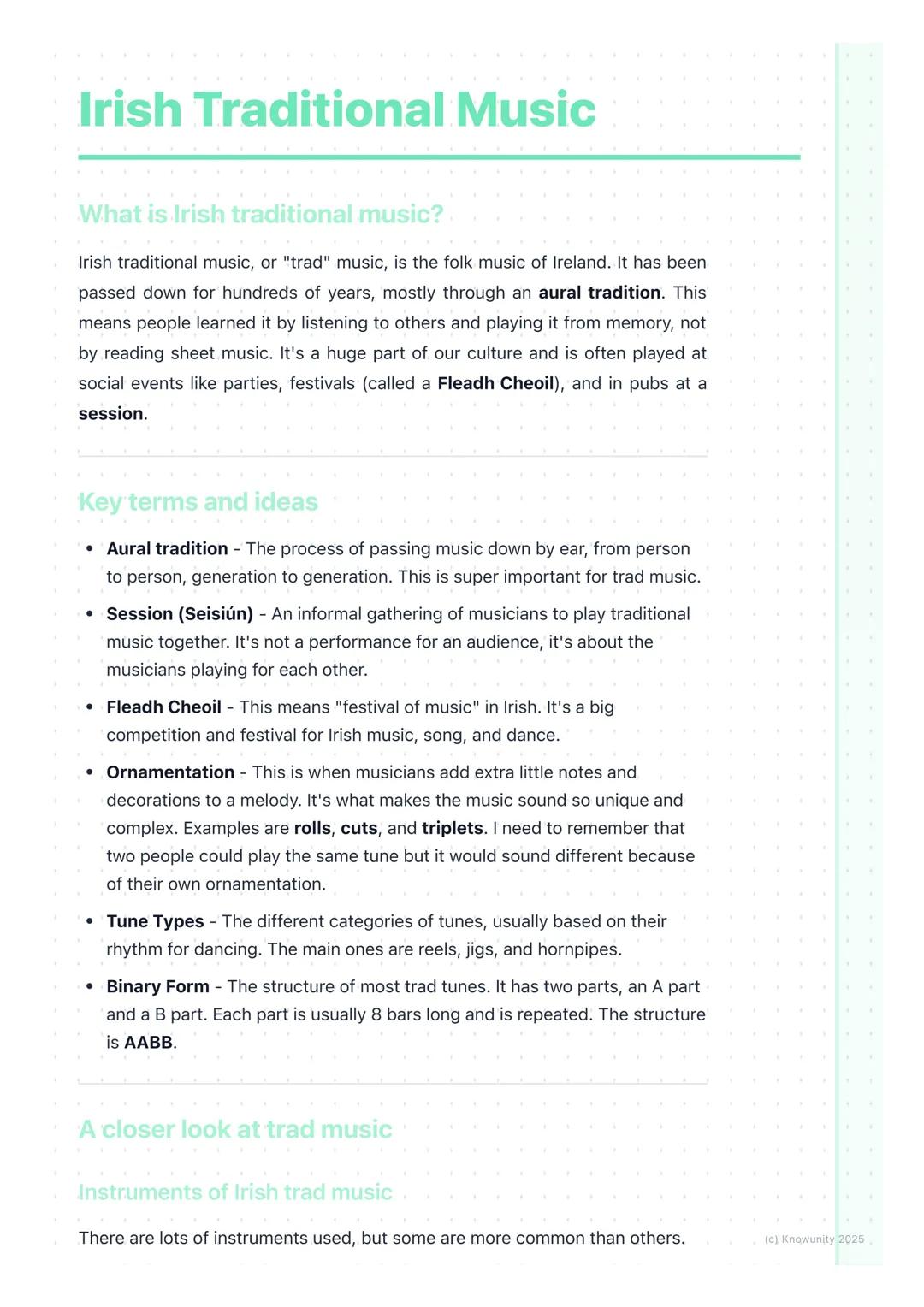
What is Irish Traditional Music?
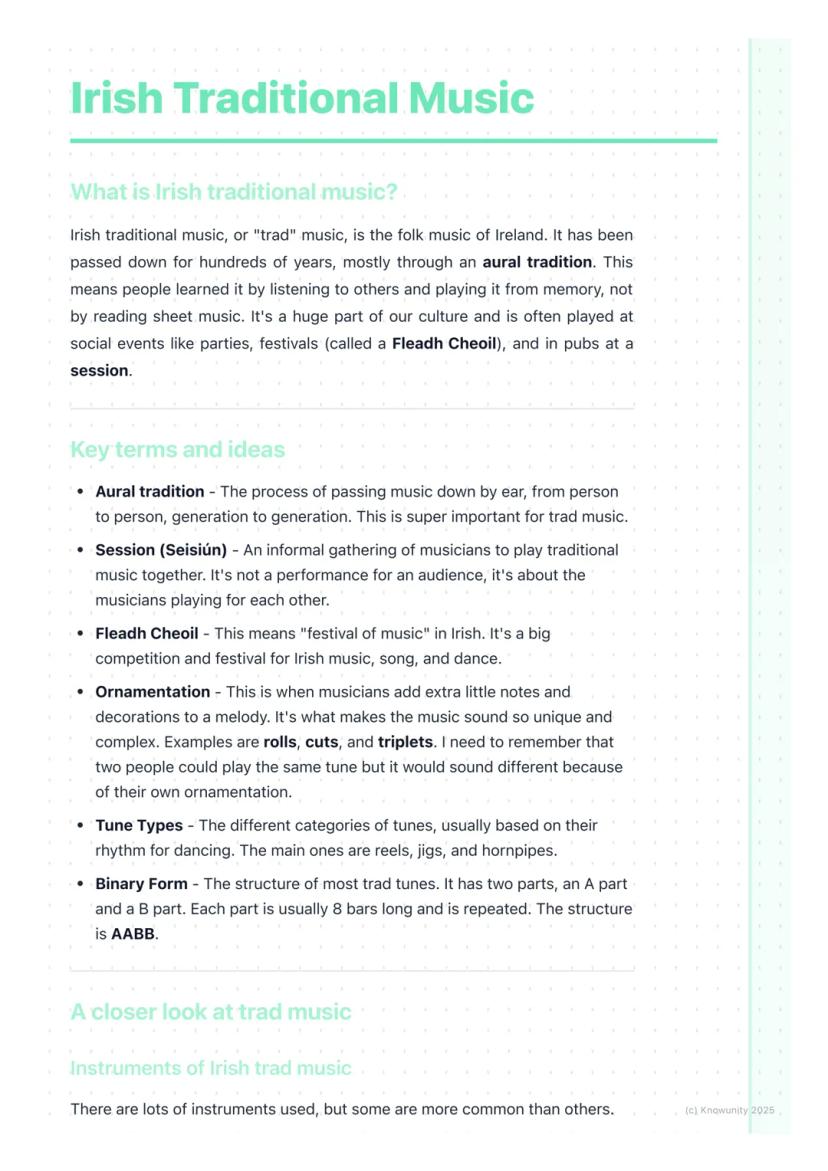
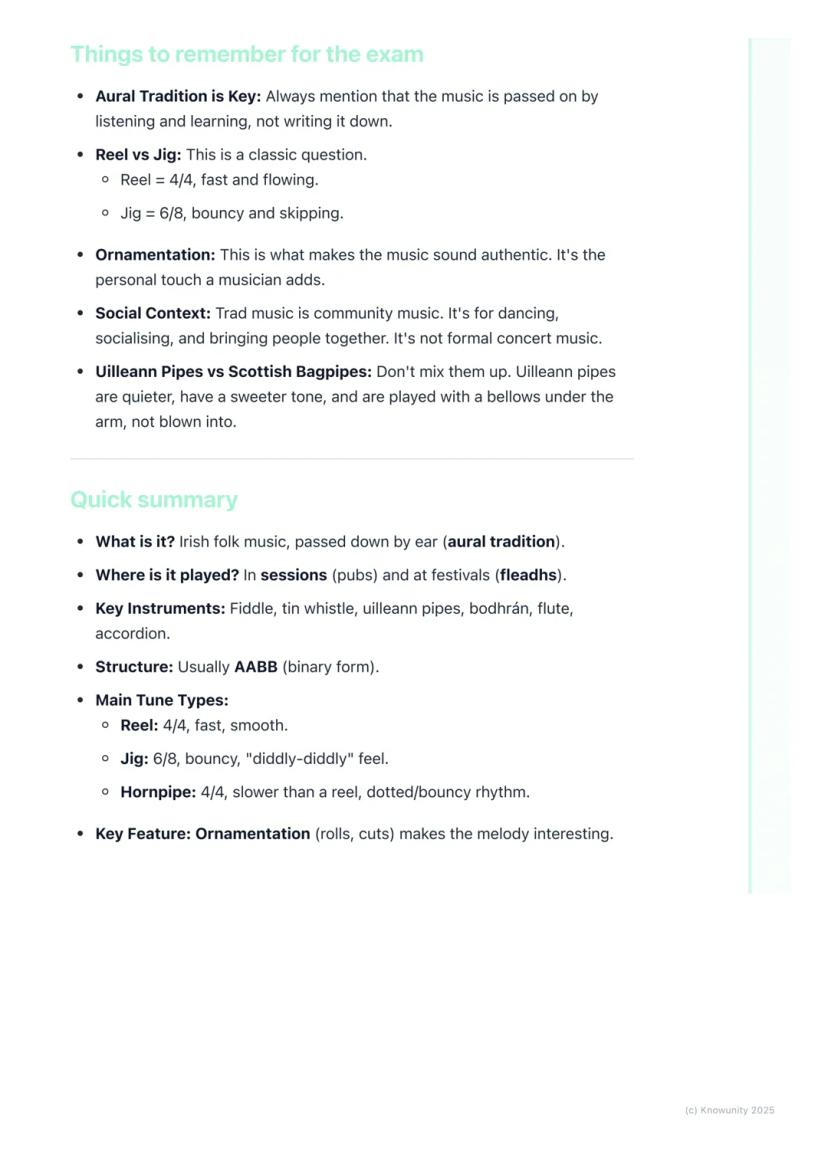
Ever wondered why Irish music sounds so distinctive and alive? Irish traditional music has survived for centuries through something called aural tradition - meaning people learned tunes by listening and playing from memory rather than reading sheet music. This creates a personal connection between musicians that you can actually hear in the music.
You'll encounter this music everywhere in Ireland, from informal sessions in pubs where musicians gather to play together, to massive Fleadh Cheoil festivals that celebrate Irish culture. These aren't performances for audiences - they're musicians playing for the pure joy of it.
The magic happens through ornamentation - those little decorative notes like rolls, cuts, and triplets that make each musician's version unique. Two people can play the same tune, but it'll sound completely different because of their personal ornamental style.
💡 Remember: Most Irish tunes follow binary form (AABB structure) - an A section and B section, each 8 bars long and repeated.
2
of 5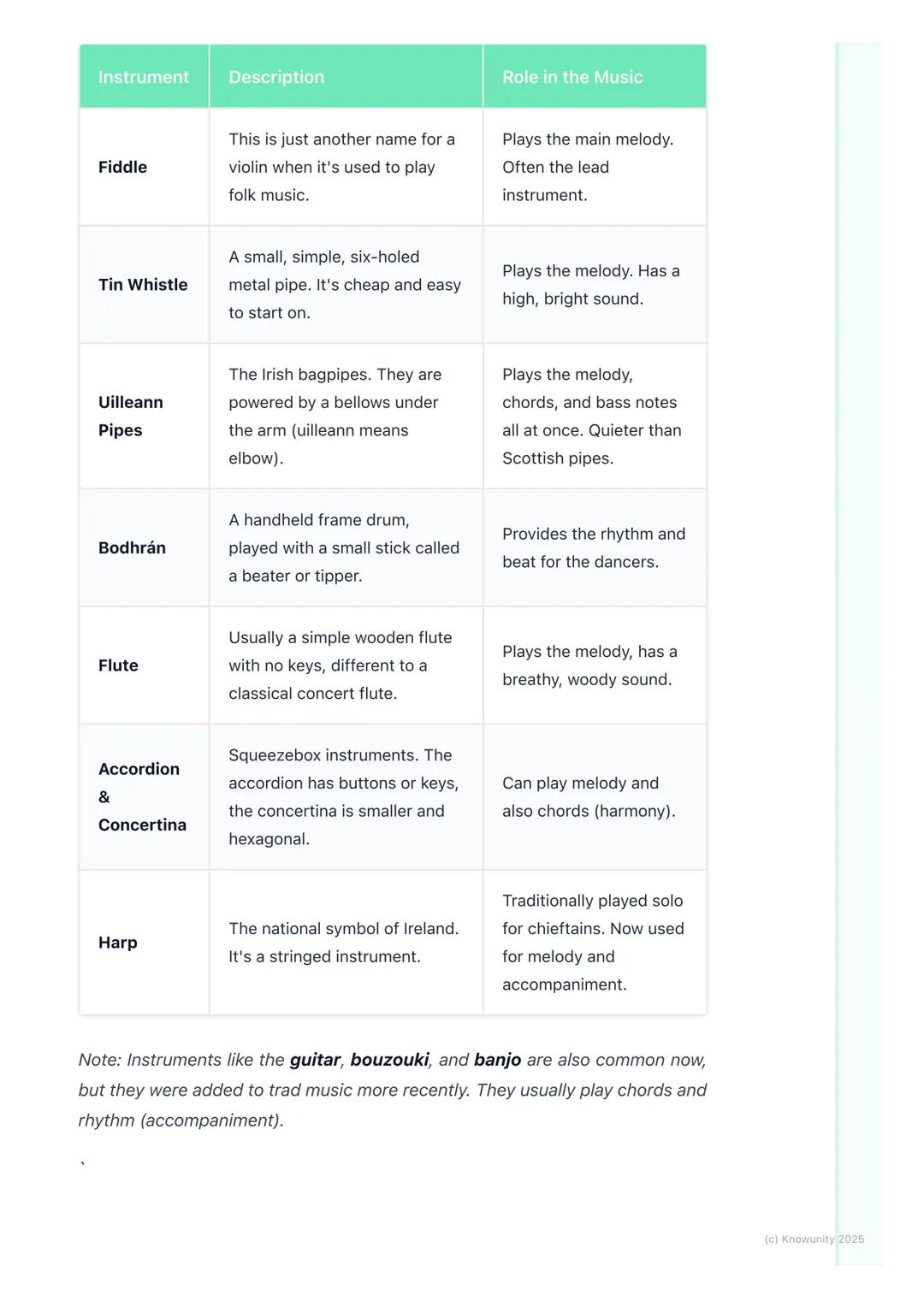
Traditional Irish Instruments
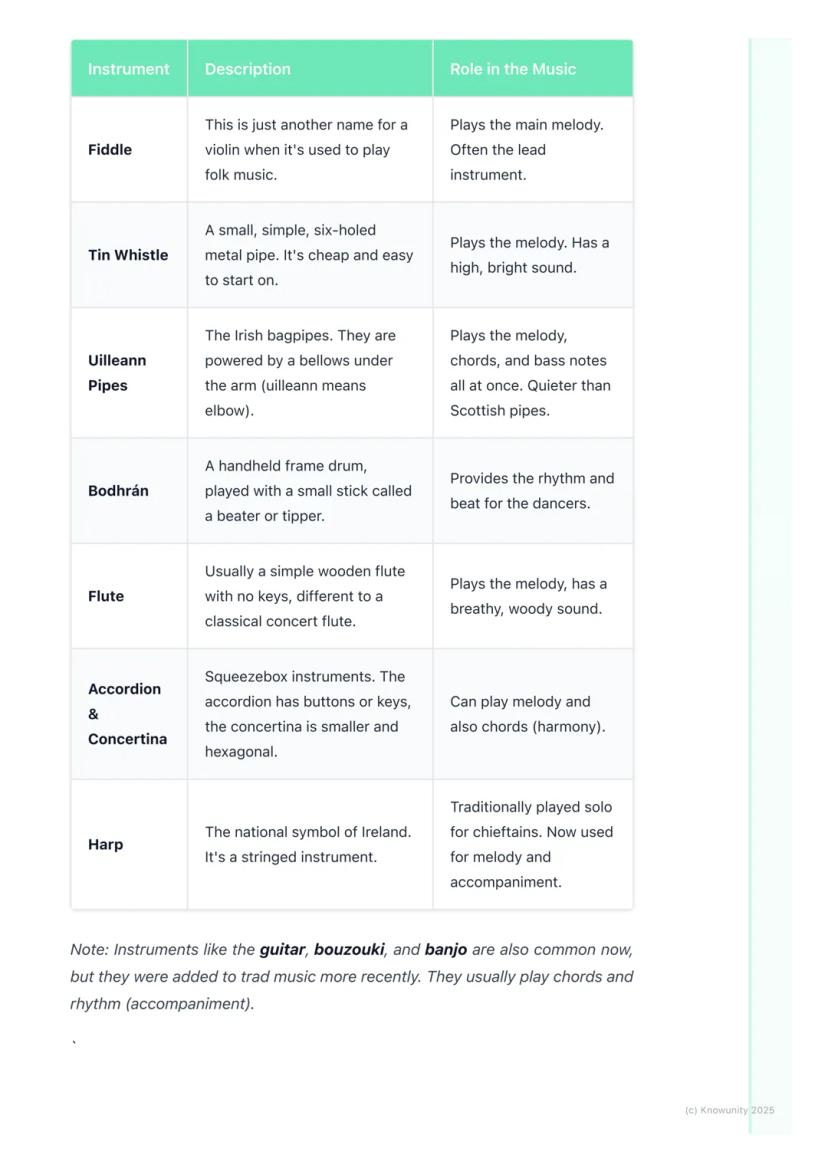
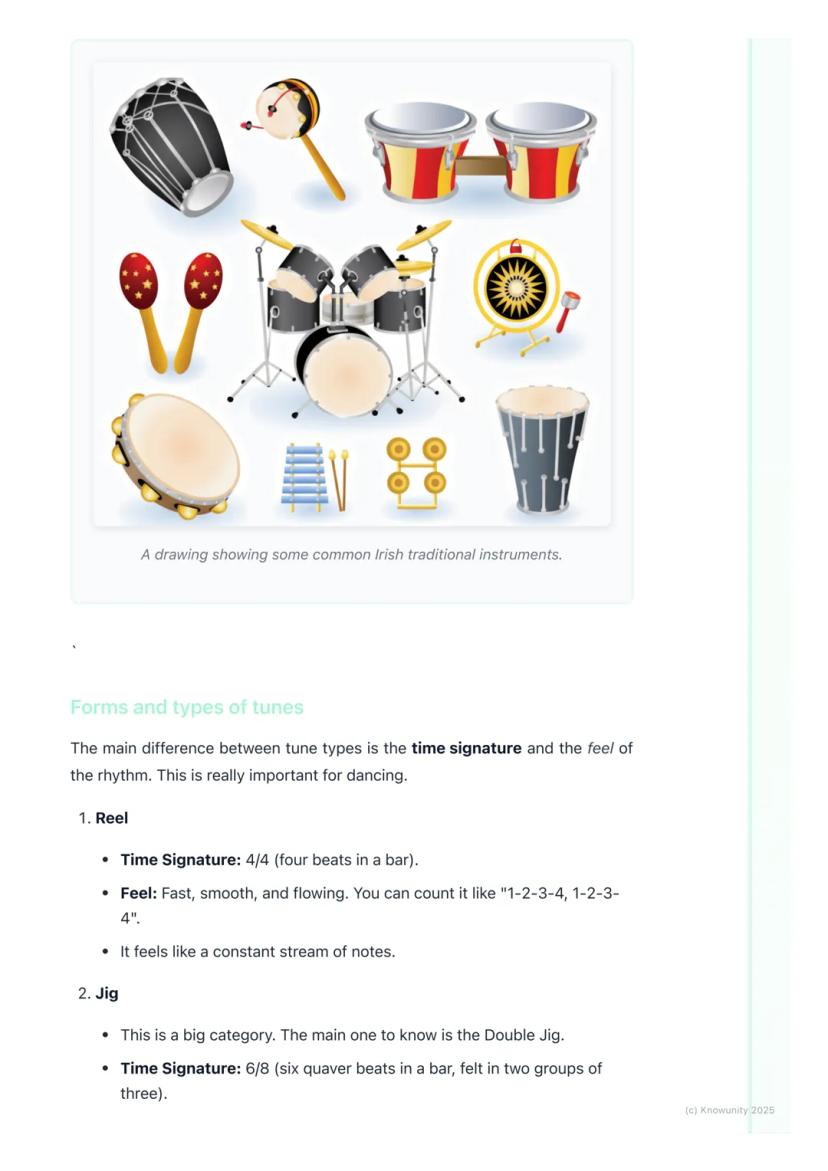
The fiddle (which is just a violin playing folk music) often leads the melody with its expressive, singing tone. For beginners, the tin whistle is brilliant - it's cheap, portable, and produces that bright, piercing sound you hear in Irish music.
Uilleann pipes are Ireland's answer to bagpipes, but they're powered by bellows under your arm (uilleann means "elbow") rather than breath. They're much quieter than Scottish pipes and can play melody, harmony, and bass all at once. The bodhrán provides the driving rhythm that gets dancers moving.
Traditional melody instruments also include wooden flutes and accordions or concertinas. The harp, Ireland's national symbol, was historically played for chieftains but now fits into modern sessions too.
💡 Quick tip: Instruments like guitar and banjo were added later for accompaniment - they're common now but aren't originally Irish.
3
of 5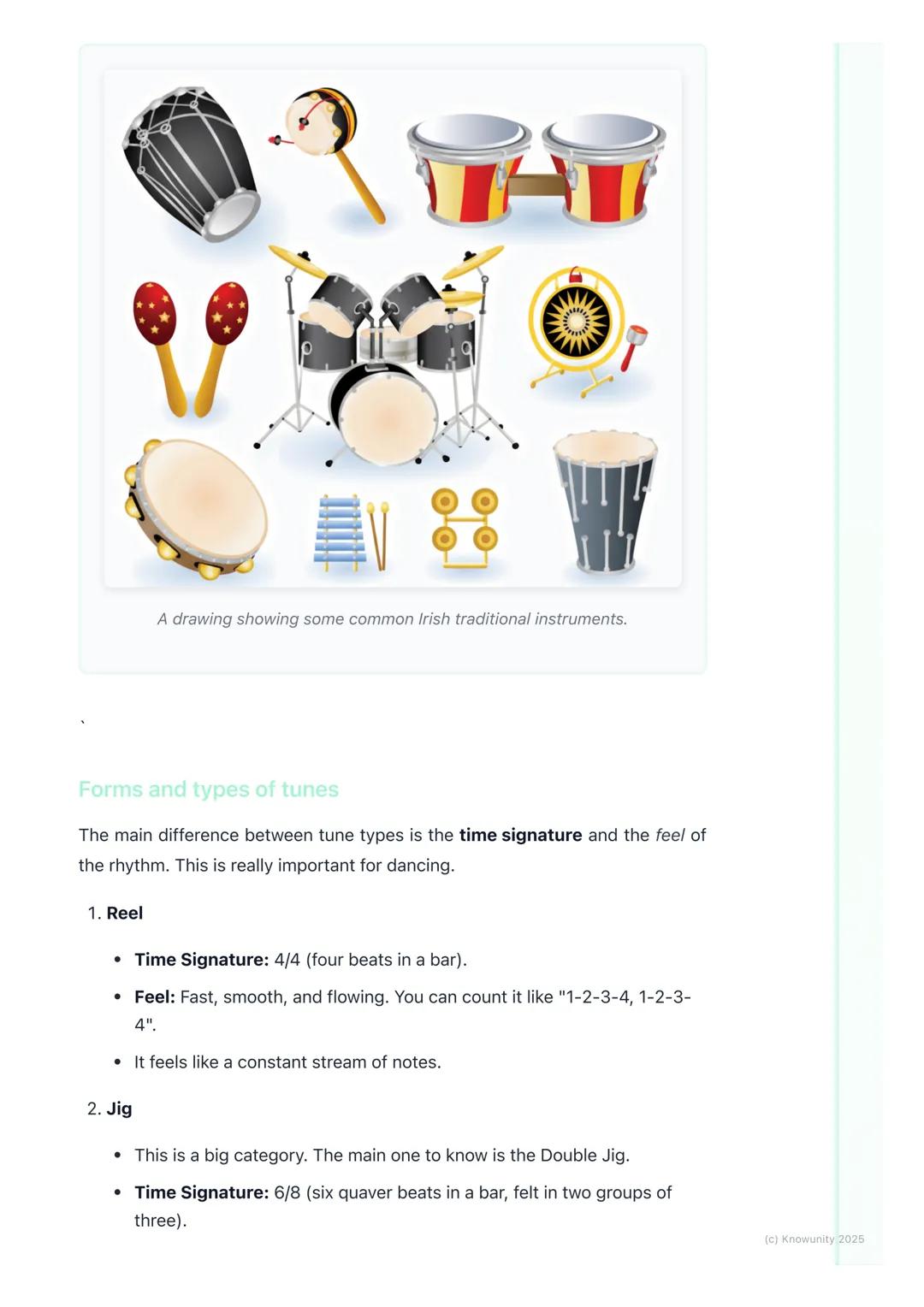
Understanding Tune Types
Learning to recognise different tune types is crucial because they determine how people dance. The rhythm and time signature completely change the feel of the music.
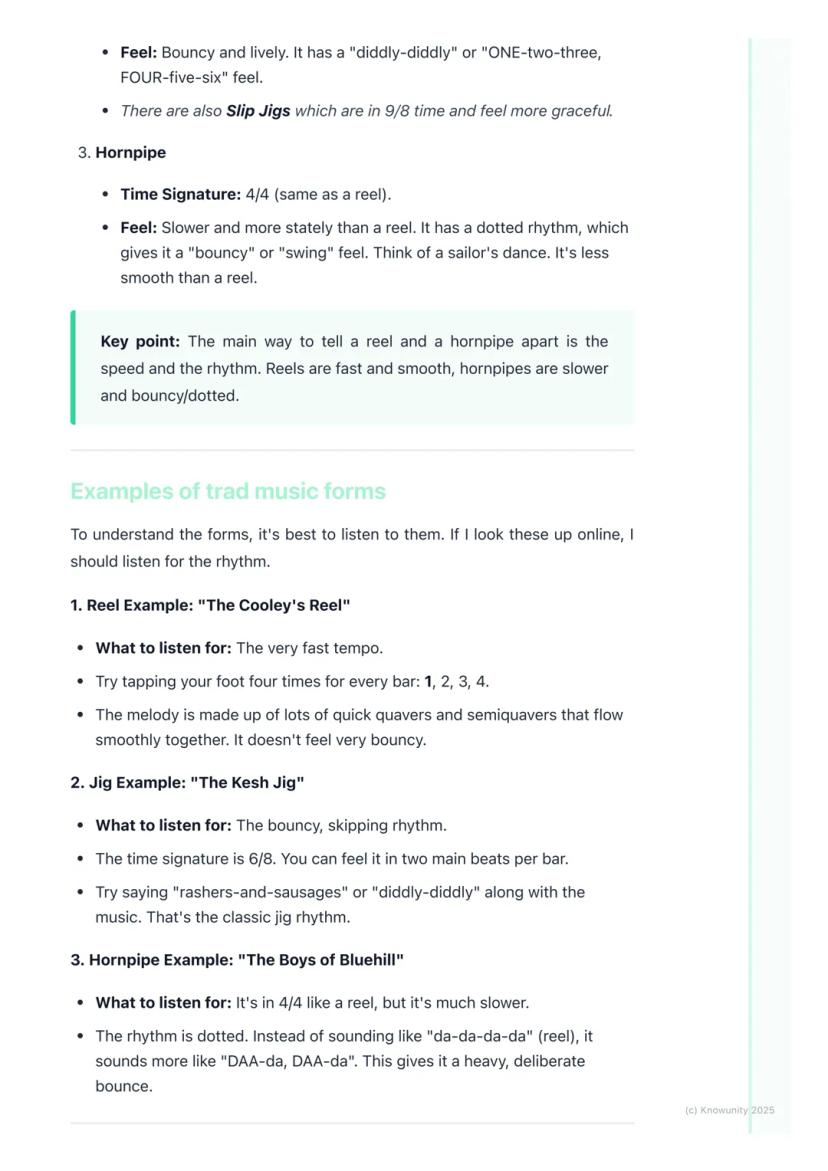
Reels are in 4/4 time and feel fast, smooth, and flowing like a constant stream of notes. Count "1-2-3-4" and tap your foot - that's a reel's steady pulse. They're probably the most common type you'll hear.
Jigs are the bouncy ones in 6/8 time that make you want to skip. The classic double jig has that "diddly-diddly" or "ONE-two-three, FOUR-five-six" feel. There are also slip jigs in 9/8 time that feel more graceful and flowing.
💡 Listen for: "The Cooley's Reel" and "The Kesh Jig" online to hear the difference - your ears will pick up the rhythmic patterns quickly.
4
of 5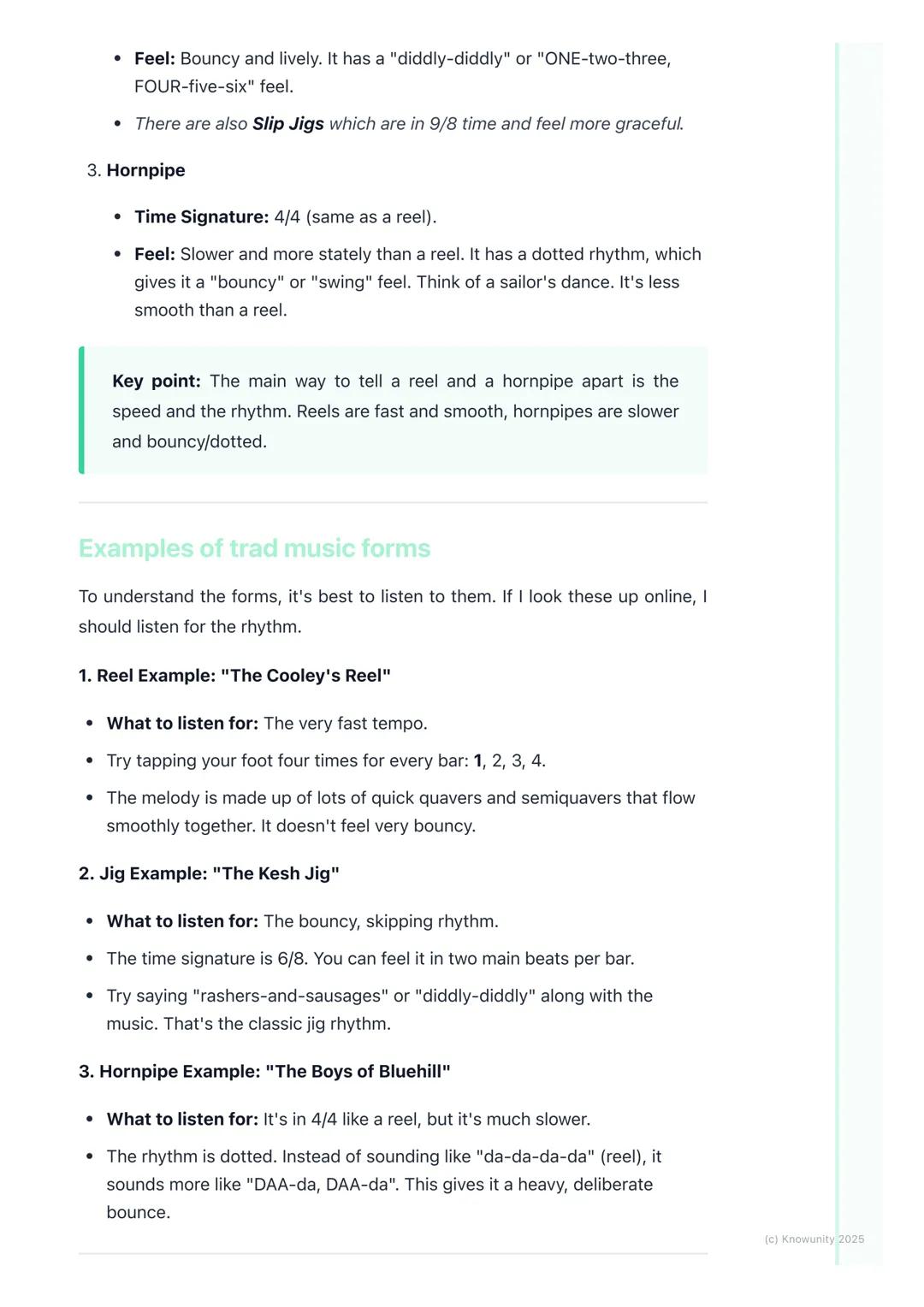
Hornpipes and Musical Examples
Hornpipes often confuse students because they're also in 4/4 like reels, but they're completely different in character. They're slower and have a dotted, bouncy rhythm that sounds like "DAA-da, DAA-da" instead of a reel's smooth "da-da-da-da". Think of a sailor's dance - deliberate and stately.
"The Boys of Bluehill" is a perfect hornpipe example. When you listen, notice how much heavier and more deliberate it sounds compared to a flowing reel. The dotted rhythms give it that characteristic swing feel.
The key difference between reels and hornpipes isn't just tempo - it's the entire rhythmic character. Reels flow like water, whilst hornpipes bounce with purpose.
💡 Exam tip: If you can distinguish between smooth flowing (reel) and bouncy dotted (hornpipe), you'll nail this topic in tests.
5
of 5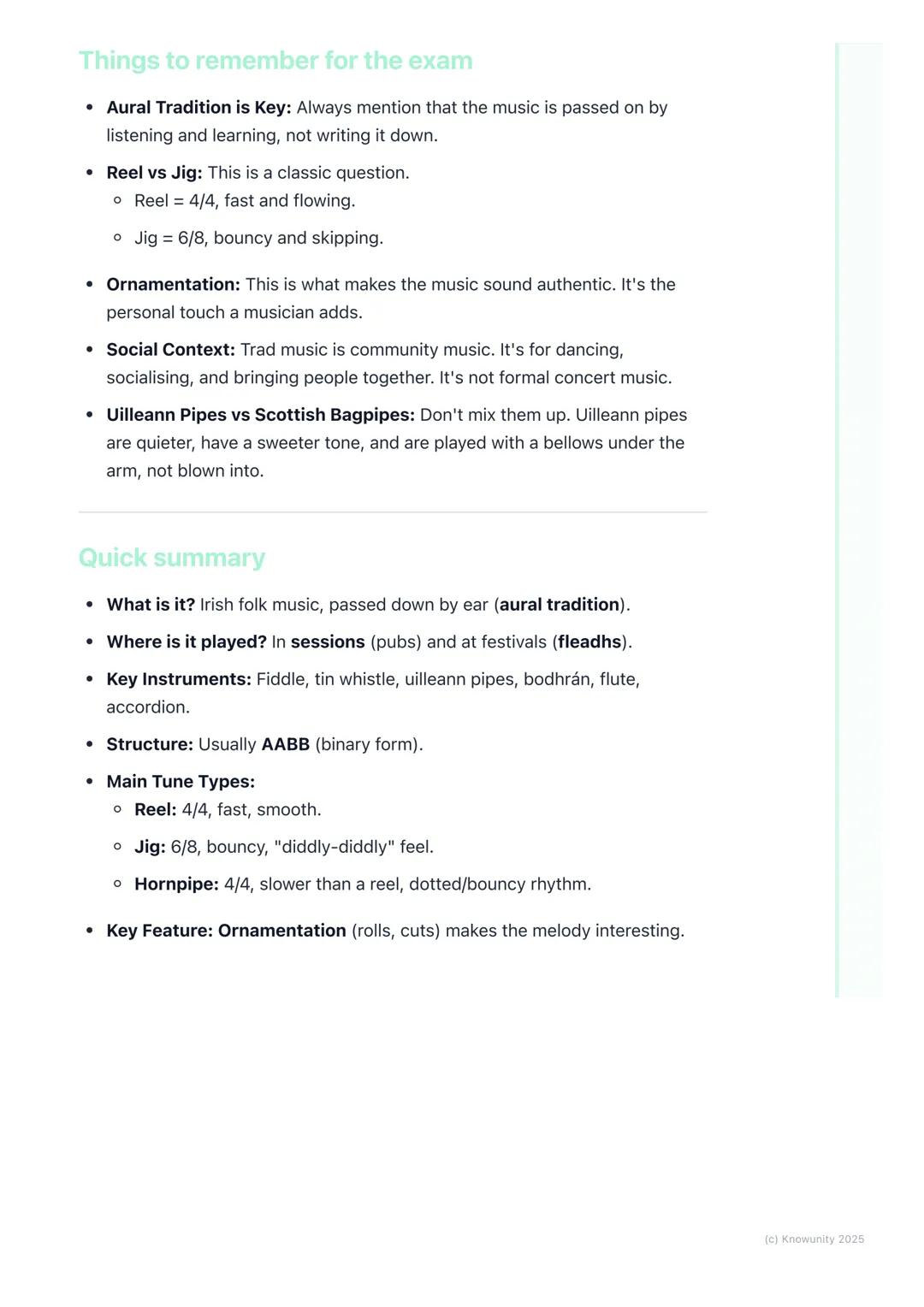
Key Points for Success
Aural tradition is the foundation of everything - always mention that this music lives through listening and learning by ear, not written notation. This creates the personal, intimate quality that makes Irish music so special.
Social context matters hugely. This isn't formal concert music - it's community music for dancing, socialising, and bringing people together. Sessions and fleadhs are where the tradition stays alive.
Ornamentation is what makes the music authentic and personal. It's how musicians add their own voice to ancient tunes, making each performance unique even when playing the same melody.
💡 Quick reference: Reel = 4/4 fast and smooth; Jig = 6/8 bouncy "diddly-diddly"; Hornpipe = 4/4 slower with dotted rhythm.
Remember that uilleann pipes are distinctly Irish - don't confuse them with Scottish bagpipes. They're quieter, sweeter, and use bellows instead of breath. Master these distinctions and you'll understand the heart of Irish traditional music.
Pensamos que nunca lo preguntarías...
¿Qué es Knowunity AI companion?
Nuestro compañero de IA está específicamente adaptado a las necesidades de los estudiantes. Basándonos en los millones de contenidos que tenemos en la plataforma, podemos dar a los estudiantes respuestas realmente significativas y relevantes. Pero no se trata solo de respuestas, el compañero también guía a los estudiantes a través de sus retos de aprendizaje diarios, con planes de aprendizaje personalizados, cuestionarios o contenidos en el chat y una personalización del 100% basada en las habilidades y el desarrollo de los estudiantes.
¿Dónde puedo descargar la app Knowunity?
Puedes descargar la app en Google Play Store y Apple App Store.
¿Knowunity es totalmente gratuito?
¡Sí lo es! Tienes acceso totalmente gratuito a todo el contenido de la app, puedes chatear con otros alumnos y recibir ayuda inmeditamente. Puedes ganar dinero utilizando la aplicación, que te permitirá acceder a determinadas funciones.
Contenidos más populares
9 Irish
IrishIrish oral questions and answers
Questions and answers for the leaving cert oral
5th Year4254
IrishIrish oral questions
Outline of oral questions
5th Year2055
IrishGaeilge Grammar Office
All the basics you need to know on Irish grammar.
3rd Year873
 English
Key Quotes : Sive
Key Quotes and explanations: Sive
6th Year2191
IrishAn Gaeilge Aiste
Irish Language essay
6th Year1250
IrishIrish poetry 2027
Iníon + Dínit an Bhróin
5th Year1133
IrishMé Féin & Mo Chlann (Myself & My Family)
Students will learn vocabulary to describe themselves, their family members, and daily routines. This helps in personal introductions and discussions.
TY291
IrishLC HL notes- Iníon (poem)
Includes poem in English and Irish, theme, key words & phrases
5th Year2284
 Geography
Territory, economic activities in Paris basin
essay
6th Year80
¿No encuentras lo que buscas? Explora otros temas.
Mira lo que dicen nuestros usuarios. Les encantó — y a ti también te encantará.
4.6/5App Store
4.7/5Google Play
La app es muy fácil de usar y está muy bien diseñada. Hasta ahora he encontrado todo lo que estaba buscando y he podido aprender mucho de las presentaciones. Definitivamente utilizaré la aplicación para un examen de clase. Y, por supuesto, también me sirve mucho de inspiración.
Pablousuario de iOS
Esta app es realmente genial. Hay tantos apuntes de clase y ayuda [...]. Tengo problemas con matemáticas, por ejemplo, y la aplicación tiene muchas opciones de ayuda. Gracias a Knowunity, he mejorado en mates. Se la recomiendo a todo el mundo.
Elenausuaria de Android
Vaya, estoy realmente sorprendida. Acabo de probar la app porque la he visto anunciada muchas veces y me he quedado absolutamente alucinada. Esta app es LA AYUDA que quieres para el insti y, sobre todo, ofrece muchísimas cosas, como ejercicios y hojas informativas, que a mí personalmente me han sido MUY útiles.
Anausuaria de iOS
Music2 vistas·Actualizado May 20, 2026·5 páginasExploring Irish Traditional Music: Instruments, Forms, and Culture
Irish traditional music, or "trad" music, is the heartbeat of Irish culture that's been passed down through generations by ear. This folk music isn't just entertainment - it's a living tradition that brings communities together in pubs, festivals, and social... Mostrar más
1
of 5Inscríbete para ver los apuntes. ¡Es gratis!
- Acceso a todos los documentos
- Mejora tus notas
- Únete a millones de estudiantes
What is Irish Traditional Music?
Ever wondered why Irish music sounds so distinctive and alive? Irish traditional music has survived for centuries through something called aural tradition - meaning people learned tunes by listening and playing from memory rather than reading sheet music. This creates a personal connection between musicians that you can actually hear in the music.
You'll encounter this music everywhere in Ireland, from informal sessions in pubs where musicians gather to play together, to massive Fleadh Cheoil festivals that celebrate Irish culture. These aren't performances for audiences - they're musicians playing for the pure joy of it.
The magic happens through ornamentation - those little decorative notes like rolls, cuts, and triplets that make each musician's version unique. Two people can play the same tune, but it'll sound completely different because of their personal ornamental style.
💡 Remember: Most Irish tunes follow binary form (AABB structure) - an A section and B section, each 8 bars long and repeated.
2
of 5Inscríbete para ver los apuntes. ¡Es gratis!
- Acceso a todos los documentos
- Mejora tus notas
- Únete a millones de estudiantes
Traditional Irish Instruments
The fiddle (which is just a violin playing folk music) often leads the melody with its expressive, singing tone. For beginners, the tin whistle is brilliant - it's cheap, portable, and produces that bright, piercing sound you hear in Irish music.
Uilleann pipes are Ireland's answer to bagpipes, but they're powered by bellows under your arm (uilleann means "elbow") rather than breath. They're much quieter than Scottish pipes and can play melody, harmony, and bass all at once. The bodhrán provides the driving rhythm that gets dancers moving.
Traditional melody instruments also include wooden flutes and accordions or concertinas. The harp, Ireland's national symbol, was historically played for chieftains but now fits into modern sessions too.
💡 Quick tip: Instruments like guitar and banjo were added later for accompaniment - they're common now but aren't originally Irish.
3
of 5Inscríbete para ver los apuntes. ¡Es gratis!
- Acceso a todos los documentos
- Mejora tus notas
- Únete a millones de estudiantes
Understanding Tune Types
Learning to recognise different tune types is crucial because they determine how people dance. The rhythm and time signature completely change the feel of the music.
Reels are in 4/4 time and feel fast, smooth, and flowing like a constant stream of notes. Count "1-2-3-4" and tap your foot - that's a reel's steady pulse. They're probably the most common type you'll hear.
Jigs are the bouncy ones in 6/8 time that make you want to skip. The classic double jig has that "diddly-diddly" or "ONE-two-three, FOUR-five-six" feel. There are also slip jigs in 9/8 time that feel more graceful and flowing.
💡 Listen for: "The Cooley's Reel" and "The Kesh Jig" online to hear the difference - your ears will pick up the rhythmic patterns quickly.
4
of 5Inscríbete para ver los apuntes. ¡Es gratis!
- Acceso a todos los documentos
- Mejora tus notas
- Únete a millones de estudiantes
Hornpipes and Musical Examples
Hornpipes often confuse students because they're also in 4/4 like reels, but they're completely different in character. They're slower and have a dotted, bouncy rhythm that sounds like "DAA-da, DAA-da" instead of a reel's smooth "da-da-da-da". Think of a sailor's dance - deliberate and stately.
"The Boys of Bluehill" is a perfect hornpipe example. When you listen, notice how much heavier and more deliberate it sounds compared to a flowing reel. The dotted rhythms give it that characteristic swing feel.
The key difference between reels and hornpipes isn't just tempo - it's the entire rhythmic character. Reels flow like water, whilst hornpipes bounce with purpose.
💡 Exam tip: If you can distinguish between smooth flowing (reel) and bouncy dotted (hornpipe), you'll nail this topic in tests.
5
of 5Inscríbete para ver los apuntes. ¡Es gratis!
- Acceso a todos los documentos
- Mejora tus notas
- Únete a millones de estudiantes
Key Points for Success
Aural tradition is the foundation of everything - always mention that this music lives through listening and learning by ear, not written notation. This creates the personal, intimate quality that makes Irish music so special.
Social context matters hugely. This isn't formal concert music - it's community music for dancing, socialising, and bringing people together. Sessions and fleadhs are where the tradition stays alive.
Ornamentation is what makes the music authentic and personal. It's how musicians add their own voice to ancient tunes, making each performance unique even when playing the same melody.
💡 Quick reference: Reel = 4/4 fast and smooth; Jig = 6/8 bouncy "diddly-diddly"; Hornpipe = 4/4 slower with dotted rhythm.
Remember that uilleann pipes are distinctly Irish - don't confuse them with Scottish bagpipes. They're quieter, sweeter, and use bellows instead of breath. Master these distinctions and you'll understand the heart of Irish traditional music.
Pensamos que nunca lo preguntarías...
¿Qué es Knowunity AI companion?
Nuestro compañero de IA está específicamente adaptado a las necesidades de los estudiantes. Basándonos en los millones de contenidos que tenemos en la plataforma, podemos dar a los estudiantes respuestas realmente significativas y relevantes. Pero no se trata solo de respuestas, el compañero también guía a los estudiantes a través de sus retos de aprendizaje diarios, con planes de aprendizaje personalizados, cuestionarios o contenidos en el chat y una personalización del 100% basada en las habilidades y el desarrollo de los estudiantes.
¿Dónde puedo descargar la app Knowunity?
Puedes descargar la app en Google Play Store y Apple App Store.
¿Knowunity es totalmente gratuito?
¡Sí lo es! Tienes acceso totalmente gratuito a todo el contenido de la app, puedes chatear con otros alumnos y recibir ayuda inmeditamente. Puedes ganar dinero utilizando la aplicación, que te permitirá acceder a determinadas funciones.
Contenidos más populares
9IrishIrish oral questions and answers
Questions and answers for the leaving cert oral
5th Year4254
IrishIrish oral questions
Outline of oral questions
5th Year2055
IrishGaeilge Grammar Office
All the basics you need to know on Irish grammar.
3rd Year873
EnglishKey Quotes : Sive
Key Quotes and explanations: Sive
6th Year2191
IrishAn Gaeilge Aiste
Irish Language essay
6th Year1250
IrishIrish poetry 2027
Iníon + Dínit an Bhróin
5th Year1133
IrishMé Féin & Mo Chlann (Myself & My Family)
Students will learn vocabulary to describe themselves, their family members, and daily routines. This helps in personal introductions and discussions.
TY291
IrishLC HL notes- Iníon (poem)
Includes poem in English and Irish, theme, key words & phrases
5th Year2284
GeographyTerritory, economic activities in Paris basin
essay
6th Year80
¿No encuentras lo que buscas? Explora otros temas.
Mira lo que dicen nuestros usuarios. Les encantó — y a ti también te encantará.
4.6/5App Store
4.7/5Google Play
La app es muy fácil de usar y está muy bien diseñada. Hasta ahora he encontrado todo lo que estaba buscando y he podido aprender mucho de las presentaciones. Definitivamente utilizaré la aplicación para un examen de clase. Y, por supuesto, también me sirve mucho de inspiración.
Pablousuario de iOS
Esta app es realmente genial. Hay tantos apuntes de clase y ayuda [...]. Tengo problemas con matemáticas, por ejemplo, y la aplicación tiene muchas opciones de ayuda. Gracias a Knowunity, he mejorado en mates. Se la recomiendo a todo el mundo.
Elenausuaria de Android
Vaya, estoy realmente sorprendida. Acabo de probar la app porque la he visto anunciada muchas veces y me he quedado absolutamente alucinada. Esta app es LA AYUDA que quieres para el insti y, sobre todo, ofrece muchísimas cosas, como ejercicios y hojas informativas, que a mí personalmente me han sido MUY útiles.
Anausuaria de iOS